
Fees & Rebates
Binance fees: reading the official table for what you pay
0.1% is one cell: regular user, spot, before discounts. A walk through the official table — the BNB discount is 25% off not free, USDC takers pay 0.095%, plus the withdrawal fees and spreads the table never mentions.
"Binance charges 0.1%" is everywhere. It is not wrong, but it is one cell of the table — regular users, spot trading, before any discount. What actually leaves your account depends on four variables, three of which you control.
This is not about theory. It is a walk through the official table.
What the table actually looks like
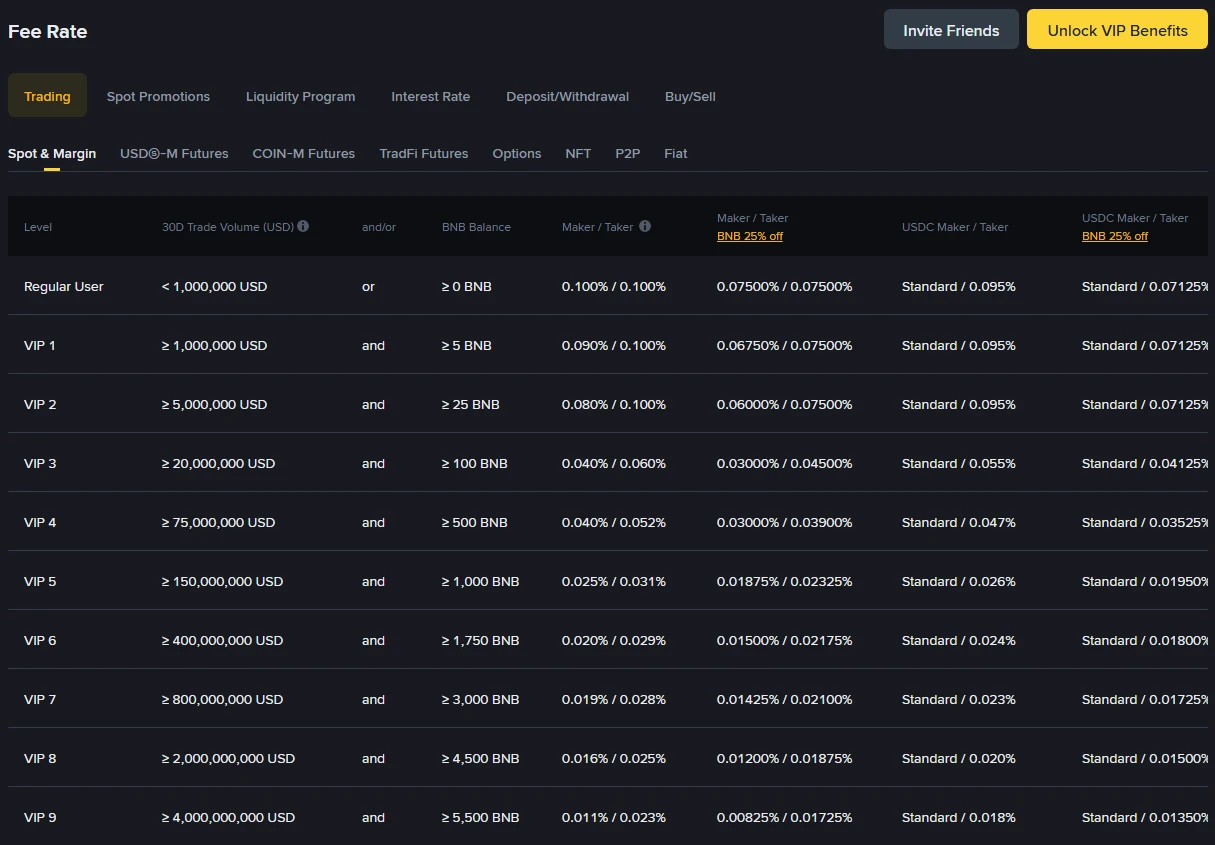
Spot & Margin, from the Binance "Fees & Transactions Overview" page, captured 9 September 2026:
As a beginner you only need the first row, Regular User. Everything below it — VIP 1 through VIP 9 — starts at a 30-day trading volume of one million USD. Not your problem yet.
The regular user row, four numbers
| Case | Maker | Taker |
|---|---|---|
| Standard | 0.100% | 0.100% |
| Paying fees in BNB (25% off) | 0.07500% | 0.07500% |
| USDC pairs | Standard | 0.095% |
| USDC pairs + BNB discount | Standard | 0.07125% |
Three things read straight off it:
One: the BNB discount is 25% off, not free trading. 0.100% × 0.75 = 0.075%, so a quarter comes off. It requires holding BNB and switching on "use BNB to pay fees" in settings. Without that, the column does not apply to you.
Two: USDC pairs carry a lower taker fee. The table says 0.095% against the usual 0.100%, and 0.07125% stacked with the BNB discount. Not a dramatic gap, but if you were buying a USDC-quoted asset anyway, picking the right pair costs you nothing.
Three: at regular-user level, maker and taker are identical. Both 0.100%. They only diverge at VIP 1 (0.090% / 0.100%). So agonising over "maker fees are cheaper" is wasted effort early on — the real value of a limit order is controlling your price, not saving fees.
What a 1,000 USDT trade actually costs
Regular user, non-USDC pair:
- BNB discount off: 1,000 × 0.100% = 1 USDT
- BNB discount on: 1,000 × 0.075% = 0.75 USDT
A quarter of a USDT. Sounds ignorable, except it is charged on every leg: once when you buy, again when you sell. A 1,000 USDT round trip is 2 USDT, or 1.5 with the discount.
Where beginners actually lose money is not that 0.025% gap. It is the costs this table does not cover.
Three costs the table does not reach
Withdrawal fees. Most people meet these on their first transfer out. They are charged as a fixed quantity per coin and network, unrelated to the amount — withdrawing 20 USDT and 2,000 USDT can cost the same. On small withdrawals the proportion gets absurd. Which chain you pick matters enormously; read the number on the withdrawal page before you send.
Same coin, 33x the fee shows the gap using real rows from the official table.
The spread on Buy/Sell. Buying directly with a card or through the Buy/Sell entry gives you a single quoted price with the cost generally folded in. That is not the same as placing your own order on the spot market. Convenience is fine — just do not do your arithmetic as though it were the 0.1% spot rate.
The spread on P2P. P2P pages routinely advertise "zero fees", but the merchant's price already carries a margin. The real cost is their quote against the market price at that moment, not whether a fee line exists.
P2P has a trap that costs more than the spread, and it sits in the limit column: see the cheapest P2P price you probably cannot use.
How to check what you were actually charged
Do not take anyone's number for it, this article included. Look at your own fills:
- Find the trade in your spot order history
- The record lists quantity, total, the fee, and which asset the fee was taken in
- Fee ÷ total is the rate you actually paid on that trade
If the BNB discount is on, the fee comes out in BNB rather than the quote asset. It looks wrong the first time. It is not.
Get into the habit of noting those three figures — total, fee, fee asset. Whether you are reconciling a rebate or reporting later, that is what you will need.
Rebates and cheaper fees are two different things
Worth untangling: a rebate returns part of the fee you already paid. It does not reduce what you pay. You pay the rate above, then a share comes back under whatever rules apply.
So switching on the BNB discount and receiving a rebate are not in conflict. Both can run at once.
Sign-up entries on this site are referral links and this site earns a commission — stating the funding up front. The sign-up page's own left panel says "Up to 20% Trade Rebates" (checked 2026-09-09). Read that as a ceiling: 20% is the maximum, not a guarantee, and what applies to you depends on tier, region and the campaign terms of the day. Your screen at sign-up is what counts.
If you do not have an account yet, this site's Binance sign-up page lists what to check first, with the referral code already on the link.
Table data from the Spot & Margin tab of the Binance "Fees & Transactions Overview" page, verified by screenshot on 2026-09-09. Rates get adjusted and vary by account, region and promotion — go by what your own account page shows. If it differs from this, tell us.
This is an independent content site, not Binance and not its support team.